Fire Alarms
Design, installation, commissioning, servicing, and 24/7 monitoring of fire detection and alarm systems to BS 5839-1:2025.
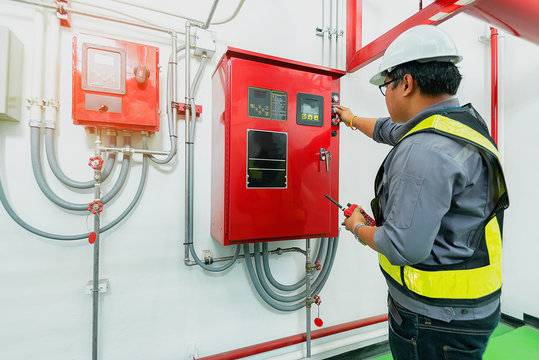
BAFE-Accredited Fire Detection & Alarm Systems
KS & A Security Solutions delivers end-to-end fire detection and alarm system services from our base in Watford. Since 2026, we have protected commercial, industrial, and residential properties across London, Hertfordshire, and the Home Counties. We hold NSI Fire Gold certification and BAFE SP203-1 accreditation — your assurance that every system we touch meets the highest standards of design, installation, and maintenance.
Fire alarms save lives. They are not optional extras. Under the Regulatory Reform (Fire Safety) Order 2005, the Responsible Person for any non-domestic premises must carry out a fire risk assessment and implement appropriate fire detection measures. We help you meet that legal duty with systems that work when it matters.
Our Fire Alarm Services
Design & Installation
Every building is different. A Category L1 system covering an entire hospital is a world apart from a Category M manual system in a small office. Our designers map your premises against the recommendations of BS 5839-1:2025, producing detailed zone plans, cause-and-effect matrices, and device schedules before a single cable is pulled.
Our installation teams are directly employed. No subcontractors. Every cable, detector head, sounder, and panel is installed to manufacturer specifications and the relevant British Standards. We commission each system fully — functional testing of every device, sound pressure level verification, and handover documentation including as-fitted drawings, certificates, and user training.
Servicing & Maintenance
BS 5839-1:2025 mandates a minimum of two service visits per year — every six months. Our planned preventative maintenance contracts include:
- Visual inspection of all devices, panels, and power supplies
- Functional testing of a sample of detectors, call points, and sounders on each visit
- Battery capacity tests and charger checks
- Full system walk-test on the second annual visit
- Logbook review and update
- Detailed service report with any remedial recommendations
Emergency call-out is included as standard on all maintenance contracts. We carry extensive van stock — odds are we can fix your system on the first visit.
Monitoring & Alarm Receiving Centre (ARC)
A fire alarm that nobody hears is useless. Our monitored systems connect your fire panel to a Category II Alarm Receiving Centre (ARC) via dual-path signalling — typically IP primary with 4G/radio backup. When your alarm activates, the ARC receives the signal within seconds and follows a pre-agreed escalation procedure, keyholder contact list, and, where appropriate, automatic fire brigade summoning.
The PSTN switch-off in 2027 means traditional phone-line communicators will stop working. If your system still relies on PSTN, we can upgrade your signalling to IP/4G dual-path well ahead of the deadline.
False Alarm Management
False alarms cost businesses money, disrupt operations, and — worse — breed complacency. The London Fire Brigade attends over 30,000 false alarms each year. We implement false alarm reduction strategies including:
- Detector type review (replacing smoke detectors with multi-sensor or heat detectors in kitchens, plant rooms, and dusty areas)
- Sensitivity adjustments and drift compensation
- Staff training on cooking processes, contractors, and alarm response
- Cause-and-effect programme modifications
- Investigation of repeat activations with detailed audit trails
Good alarm management can reduce false activations by 80% or more. We have achieved this for multiple clients.
Standards We Work To
BS 5839-1:2025
The 2025 revision of BS 5839-1 — effective from April 2025 — introduced several significant changes. If you have recently had a system installed or are planning a new installation, these apply to you:
-
Mandatory zone plans — A clear, accurate zone plan must be displayed adjacent to every fire alarm control panel and any repeater panels. These must be framed and show the building layout with zone boundaries, “you are here” markers, and fire exits. No more hand-drawn sketches sellotaped to the wall.
-
Cause-and-effect matrices — Every system must have a documented, site-specific cause-and-effect schedule. This defines what happens when any given device activates — which sounders operate, which doors release, whether lifts ground, whether the signal goes to the ARC. Generic “all sounders everywhere” logic is insufficient for anything beyond the simplest buildings.
-
Red mains supply cables — The mains supply cable to the fire alarm panel must now be red in colour, or clearly labelled as a fire alarm supply along its entire visible length using red sleeving or red identification tape. This is a safety-critical change aimed at preventing accidental disconnection during electrical work.
We ensure every new installation and every upgrade meets the current standard in full. If your existing system was installed before April 2025, we can survey it against the new requirements and advise on any compliance gaps.
Equipment & Manufacturers
We are independent — not tied to any single manufacturer. We specify and install equipment from the UK’s leading fire detection brands:
| Brand | Specialism |
|---|---|
| Apollo | Discovery, XP95, and Soteria addressable detectors — the most widely used commercial fire detection platform in the UK |
| Hochiki | ESP and L@titude addressable ranges with excellent false alarm immunity |
| Kentec | Syncro and Taktis control panels — robust, intuitive, and ideal for multi-panel networked sites |
| Advanced | MxPro 5 and Go panels — high-specification panels for complex cause-and-effect |
| C-TEC | XFP and ZFP ranges — cost-effective conventional and addressable panels for smaller sites |
| Morley | ZX and Dimension ranges — Honeywell-owned, widely used in retail and commercial portfolios |
We also integrate aspirating smoke detection (Vesda, ICAM) for high-value or challenging environments, and linear heat detection for car parks and industrial applications.
Frequently Asked Questions
How often should fire alarms be serviced?
Every six months. BS 5839-1:2025 Part 6 requires a minimum of two service visits per year at intervals not exceeding six months. The first visit covers visual inspection and functional testing of sample devices; the second visit includes a full system walk-test where every detector is functionally tested. If your insurer requires quarterly visits (common in higher-risk premises), we can accommodate that too. Annual testing alone does not comply with the British Standard.
What is BS 5839-1:2025?
BS 5839-1 is the British Standard for the design, installation, commissioning, and maintenance of fire detection and fire alarm systems in non-domestic premises. The 2025 revision — which took effect in April 2025 — is the current version and introduces mandatory zone plans, documented cause-and-effect matrices, and red-coloured mains supply cables. Compliance with BS 5839-1 is not a legal requirement in itself, but it is the recognised way to demonstrate compliance with the fire safety legislation that is law (the Regulatory Reform (Fire Safety) Order 2005, the Fire Safety (England) Regulations 2022).
Do I need a fire alarm system legally?
If you are the Responsible Person for any non-domestic premises — an office, shop, factory, warehouse, school, care home, hotel, pub, restaurant, or block of flats (common areas) — then yes, you have a legal obligation under the Regulatory Reform (Fire Safety) Order 2005 to carry out a fire risk assessment and provide “appropriate” fire detection and warning. What is “appropriate” depends on the building, its use, its occupants, and the fire risk. A small open-plan office might only need manual call points (Category M). A care home with sleeping residents would almost certainly need automatic detection throughout (Category L1). The starting point is always a fire risk assessment. We can recommend competent fire risk assessors if you do not already have one.
What is involved in a fire risk assessment?
A fire risk assessment is a structured, five-step process required by law: (1) Identify fire hazards — sources of ignition, fuel, and oxygen; (2) Identify people at risk — staff, visitors, sleeping occupants, and those who may need assistance to evacuate; (3) Evaluate, remove, or reduce risks — assess the likelihood of a fire and the adequacy of existing precautions; (4) Record, plan, and train — produce an emergency plan, provide staff training, and maintain records; (5) Review periodically and whenever the premises or its use changes. KS & A Security Solutions does not carry out fire risk assessments directly (this ensures independence), but we work closely with several BAFE-registered fire risk assessors whom we can recommend.
Can you take over an existing fire alarm system?
Yes, and we do this regularly. If you have an existing fire alarm system — regardless of the original installer — we can take over the servicing and maintenance. Our first step is a comprehensive system survey: we check device types and coverage, panel condition and firmware, battery health, cable condition (where accessible), cause-and-effect programming, and existing logbook records. We then issue a condition report with a quotation for any remedial work needed to bring the system to current standards. Once any critical issues are resolved, we commence a routine maintenance contract. We service systems from all manufacturers.
What about the PSTN switch-off?
The UK’s public switched telephone network (PSTN) is being retired, with full switch-off expected by January 2027. This affects fire alarm systems that use a traditional phone line to communicate with an Alarm Receiving Centre. After the switch-off, PSTN communicators will simply stop working — your alarm will sound locally but nobody will be notified. The replacement technology is dual-path signalling: an IP connection (typically via your broadband or a dedicated 4G router) with a radio (4G/LTE) backup path. Both paths are monitored continuously, and if one fails, the other takes over and the ARC is notified of the fault. If your fire alarm still relies on a PSTN communicator, contact us. We can survey your system and recommend the right signalling upgrade well before the deadline.
Your Legal Obligations
Regulatory Reform (Fire Safety) Order 2005
This is the primary fire safety legislation for England and Wales. It applies to virtually all non-domestic premises and the common areas of residential buildings. Key duties of the Responsible Person (typically the employer, owner, landlord, or managing agent):
- Carry out a fire risk assessment and keep it up to date
- Implement appropriate fire safety measures (detection, warning, means of escape, emergency lighting, fire extinguishers)
- Appoint competent fire safety assistance
- Provide information, instruction, and training to staff
- Maintain all fire safety equipment
- Keep records of risk assessments, training, and maintenance
Failure to comply is a criminal offence. Penalties include unlimited fines and imprisonment for the most serious breaches.
Fire Safety (England) Regulations 2022
Effective from 23 January 2023, these regulations impose additional duties on Responsible Persons of high-rise residential buildings (over 11 metres) and all multi-occupied residential buildings. Key fire alarm-related requirements for high-rise buildings include monthly checks of fire doors in common areas, annual checks of flat entrance doors, and secure information boxes with floor plans and building information for the fire and rescue service. For buildings over 18 metres (high-risk), the Responsible Person must also provide electronic copies of floor plans and building plans to their local fire and rescue service.
Building Safety Act 2022
This Act created the Building Safety Regulator and introduced a new regime for higher-risk buildings (defined as buildings of at least seven storeys or 18 metres in height containing at least two residential units). The Accountable Person must register their building, produce a safety case, and demonstrate ongoing management of fire safety risks. Fire alarm systems in these buildings are subject to particularly rigorous scrutiny. We can support Accountable Persons with system design, maintenance documentation, and compliance evidence.
Why Choose KS & A Security Solutions?
- BAFE SP203-1 certified — independently audited competence in fire detection and alarm system design, installation, commissioning, and maintenance
- NSI Fire Gold accredited — the highest level of third-party certification available for fire safety service providers
- Directly employed engineers — no subcontractors, no temporary staff; every person on your site works for us
- Emergency response — 24/7 call-out with extensive van stock; average attendance within four hours
- Independent advice — we recommend the right equipment for your building, not the brand with the biggest margin
- Local presence — based in Watford, serving London, Hertfordshire, Bedfordshire, Buckinghamshire, and the wider Home Counties since 2026
Next Steps
Call us on +44 7423 127081 or email info@ksasolutions.uk to discuss your fire alarm requirements. We respond to all enquiries within one working day.
Related Fire Safety Services
- Fire Extinguisher Supply & Servicing — Annual servicing and supply of all extinguisher types to BS 5306
- Emergency Lighting — Design, installation, and testing of emergency escape lighting to BS 5266
- Fire Protection Systems — Sprinklers, smoke control, fire curtains, and gas suppression
Our Fire Alarms Services
- Design & Installation
- Servicing & Maintenance
- Monitoring & Alarm Receiving Centre (ARC)
- False Alarm Management