Emergency Lighting & Fire Safety Signs
Design, installation, and testing of emergency escape lighting and fire safety signage to BS 5266. Monthly and annual testing included.
Emergency Escape Lighting & Fire Safety Signage
When the mains power fails and a building descends into darkness, emergency lighting is the difference between a calm, orderly evacuation and chaos. KS & A Security Solutions designs, installs, commissions, and maintains emergency escape lighting systems for commercial, industrial, and residential premises throughout London, Hertfordshire, and the Home Counties.
We are certified to NSI Fire Gold standard and our emergency lighting work is carried out in accordance with BS 5266-1:2016. From a single bulkhead unit in a small office corridor to a fully addressable self-testing system across a multi-occupancy high-rise, we deliver lighting that works when it matters.
What Is Emergency Lighting?
Emergency lighting is not the same as backup lighting or security lighting. Its sole purpose is to illuminate escape routes, exits, and safety equipment when the normal lighting supply fails. It encompasses three distinct sub-systems:
- Emergency escape lighting — illuminates the route to the final exit, including stairs, corridors, directional changes, and floor level changes
- Standby lighting — enables normal activities to continue during a power failure (not strictly a life-safety system, but often specified in healthcare and critical infrastructure)
- Escape route lighting with signage — combines illuminated directional signs (green running-man pictograms) with downwards illumination of the escape path
Under the Regulatory Reform (Fire Safety) Order 2005, the Responsible Person must ensure that emergency routes and exits are provided with emergency lighting of adequate intensity in case the normal lighting fails. BS 5266-1:2016 provides the detailed specification.
Our Emergency Lighting Services
Design & Installation
Effective emergency lighting design is about coverage and uniformity. BS 5266-1 specifies minimum illuminance levels at key points: 1 lux on the centre line of an escape route, 0.5 lux for open areas (anti-panic), and 15 lux at fire alarm call points and fire extinguisher locations.
Our designers produce a lighting schedule mapped to your floor plans, identifying every unit location, its type (maintained or non-maintained), its duration (typically three hours), and its luminaire classification. We calculate spacing to avoid dark spots (the ratio of maximum to minimum illuminance must not exceed 40:1 along the centre line) and ensure that every change of direction and every exit door is clearly visible.
Installation is carried out by our directly employed electricians, all of whom hold ECS cards and are experienced in fire safety systems. Every unit is wired from a dedicated circuit originating at the local lighting distribution board, with test facilities in accordance with BS 5266-1. We commission each system with a full photometric spot-check and provide handover documentation including as-fitted drawings, luminaire schedules, and a logbook.
Monthly Flick Tests
BS 5266-1 requires that every emergency light is functionally tested at least once per month. The standard calls this a “short duration test” — essentially, you simulate a mains failure and confirm that each luminaire illuminates from its battery supply. The test must be sufficient to verify that the lamp works, the battery holds charge, and the charging circuit operates.
We offer monthly flick test contracts for premises where an in-house responsible person cannot reliably carry out these checks. Our engineer attends monthly, isolates the appropriate circuits, walks every emergency luminaire to confirm operation, and records the results in your logbook. A typical monthly test takes 30-45 minutes per floor.
For multi-site portfolios — schools, retail chains, clinics — we manage the full testing schedule and provide a monthly compliance dashboard showing test completion, pass rates, and any outstanding defects.
Annual Full-Duration Tests
The annual test is the serious one. BS 5266-1 requires that every emergency luminaire is tested for its full rated duration — typically three hours — at least once per year. This means the unit must run on battery alone for the entire period while maintaining adequate light output.
Our annual test procedure:
- Isolate the normal lighting supply to each emergency lighting circuit
- Walk every luminaire at the start of the test to confirm initial illumination
- Record illuminance measurements with a calibrated lux meter at key points
- Monitor during the test — early lamp failure or battery degradation often shows mid-test
- At the conclusion of the three-hour period, walk every luminaire again. Units that fail before three hours are marked for battery or lamp replacement
- Restore the mains supply, confirm charging indicator lights are operational, and verify that all units are recharging
- Complete your logbook and issue a full test certificate
Any unit that fails the annual test is quoted for replacement or repair on the same report. We carry common battery packs and lamp modules as van stock — many failed units can be repaired on the day.
Fire Exit Signs
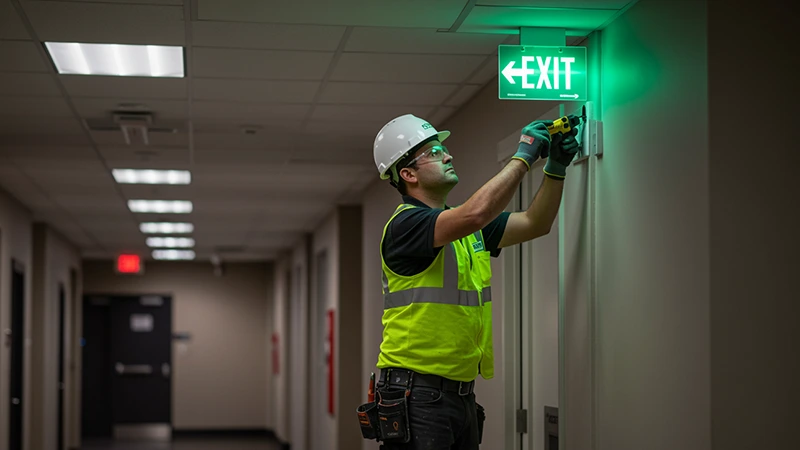
Illuminated fire exit signs are a specific category of emergency lighting covered by BS 5266-1 (sign illumination) and the Signs Directive implementing BS EN ISO 7010 (sign design — the green running-man pictogram). Signs must be positioned so that they are visible from all points on the escape route and are never more than the viewing distance for which the sign’s size is rated.
We supply and install:
- Internally illuminated edge-lit signs — slim, modern appearance, low energy consumption, commonly LED with lamella grids for even light distribution
- Photoluminescent signs — no electrical supply required; they absorb ambient light and glow in darkness. Only suitable where there is reliable ambient lighting; they must be positioned so that light falls directly on them during normal conditions
- Self-testing signs — addressable LED signs that self-test monthly and annually, logging results to the luminaire or to a central panel, with fault reporting via LED indicator or networked alarm
Every sign is mounted at the correct height (typically 2.0-2.5 metres above floor level for wall-mounted signs, or suspended from the ceiling above doors) with viewing distances calculated to the relevant standards.
Bulkhead Lights
Bulkhead emergency luminaires are the workhorses of commercial emergency lighting — robust, impact-resistant, and weather-proof where needed. We install:
- Maintained bulkheads — lit continuously (often switched with normal lighting) and remain lit on battery during power failure. Used in corridors, stairwells, and areas without borrowed light
- Non-maintained bulkheads — off during normal conditions, illuminating only on mains failure. Used where occupants are familiar with the escape route under normal lighting and the primary function is power-failure provision
- Weatherproof bulkheads (IP65) — for external escape routes, plant rooms, loading bays, and car park stairwells
- LED conversion kits — upgrade existing fluorescent bulkheads to LED, reducing energy consumption and extending battery run-time
All bulkhead luminaires we install carry a minimum three-year warranty on the LED array and battery.
Frequently Asked Questions
How often should emergency lighting be tested?
Monthly and annually. BS 5266-1:2016 requires a short functional test of every emergency luminaire each month — confirm that the lamp illuminates when mains power is disconnected — and a full rated-duration test (typically three hours) once per year. Both tests must be recorded in your emergency lighting logbook. The monthly test can be carried out by a competent in-house person; the annual test should be carried out or supervised by a qualified technician with calibrated light-measuring equipment.
What is the difference between maintained and non-maintained emergency lighting?
Maintained luminaires are lit at all times — they are wired to the normal lighting circuit and remain illuminated during normal operation. On mains failure, they switch to battery power and continue to illuminate the escape route. Non-maintained luminaires are normally off; they only illuminate when the mains supply fails. Maintained fittings are typically used in cinemas, theatres, public assembly spaces, and anywhere where occupants may be unfamiliar with the escape route. Non-maintained fittings are the default for most offices and industrial premises where occupants know the layout and only need emergency lighting during a power failure.
How long do emergency light batteries last?
Typically four to five years, though this varies with temperature, usage patterns, and unit quality. BS 5266-1 does not specify a fixed battery replacement interval — it requires that batteries are replaced when they can no longer power the luminaire for its rated duration (as identified during the annual full-duration test). In practice, most facilities managers budget for battery replacement every four years as a preventative measure, avoiding the risk of a failed annual test. LED luminaires place significantly less load on batteries than older fluorescent units, and we are seeing battery lives extending to five or even six years with good-quality LED systems.
Do I need emergency lighting in a small office?
Almost certainly yes, if the office has no borrowed light (natural daylight) and is occupied outside daylight hours or has internal rooms or corridors without windows. The criterion is simple: if the normal lighting fails during a fire, can every person in the building find their way to a place of safety without light? If the answer is no, emergency escape lighting must be provided. For very small, open-plan offices with large windows on a single floor, and where the premises are only occupied during daylight hours, the fire risk assessment may determine that emergency lighting is not necessary — but this is the exception, not the rule.
What is an addressable or self-testing emergency lighting system?
A self-testing emergency luminaire carries out its own monthly short-duration test and annual full-duration test automatically and logs the results. Individual luminaires indicate pass/fail via an LED indicator (green for pass, red/flashing for fault). Addressable systems take this further — each luminaire is connected to a data network and reports its test results to a central panel or PC, where the responsible person can view a dashboard of every luminaire’s status, test history, and any faults. Addressable systems significantly reduce the labour cost of compliance testing for larger buildings and provide an auditable compliance trail that satisfies insurers and enforcement authorities. We design and install addressable systems from several manufacturers and can advise on whether the cost is justified for your building.
Standards We Work To
BS 5266-1:2016
BS 5266-1 is the primary British Standard for emergency lighting in premises other than dwellings. It covers system design (illuminance levels, spacing, uniformity ratios, glare limits, and colour rendering), installation wiring, and testing and maintenance requirements. Key points:
- Escape routes must have a minimum of 1 lux on the centre line
- Open areas (anti-panic) require a minimum of 0.5 lux over the floor area, excluding a 0.5-metre perimeter
- High-risk task areas (plant rooms, switch rooms, industrial processes) require a minimum of 15 lux or 10% of the normal lighting level, whichever is higher
- The ratio of maximum to minimum illuminance along the escape route centre line must not exceed 40:1
- Luminaires must achieve 50% of their required illuminance level within five seconds of mains failure and 100% within sixty seconds
- All tests and defects must be recorded in a logbook
BS EN 1838
This European standard defines the specific photometric requirements for emergency lighting: the 1 lux / 0.5 lux / 15 lux minimums, the uniformity ratios, glare limits, and the colour rendering index minimum of Ra 40 (sufficient to distinguish safety colours). Our design software calculates these parameters to produce a compliant lighting schedule.
BS EN 60598-2-22
Product standard for emergency luminaires, covering construction, marking, and electrical safety requirements. All luminaires we supply comply with this standard.
Why Choose KS & A Security Solutions?
- NSI Fire Gold accredited — your emergency lighting installation and maintenance is covered by our independently audited certification
- Directly employed electricians — ECS-card-holding, experienced in fire safety systems; no agency staff, no subcontractors
- Calibrated test equipment — our lux meters are calibrated annually, and we provide photometric test certificates as part of each annual test
- Compliance tracking — we manage your test schedule and remind you when monthly and annual tests fall due
- Van stock — common batteries, LED modules, and complete luminaires are carried on every van; most defects are fixed on the first visit
- Local presence — Watford based, serving London, Hertfordshire, Bedfordshire, Buckinghamshire, and the surrounding counties since 2026
Next Steps
Call us on +44 7423 127081 or email info@ksasolutions.uk to discuss your emergency lighting requirements. We respond within one working day. Most surveys can be completed in under two hours, with a written quotation and lighting schedule delivered within three working days.
Related Fire Safety Services
- Fire Alarm Systems — Design, installation, servicing, and 24/7 monitoring to BS 5839-1:2025
- Fire Extinguisher Supply & Servicing — Annual servicing and supply of all extinguisher types to BS 5306
- Fire Protection Systems — Sprinklers, smoke control, fire curtains, and gas suppression
Our Emergency Lighting & Fire Safety Signs Services
- Design & Installation
- Monthly Flick Tests
- Annual Full-Duration Tests
- Fire Exit Signs
- Bulkhead & Maintained Lights